Buttonweeds & Similar Species


What are they?
A number of members of the daisy family have flowerheads that consist of apparently petalless, yellow flowers. Some are always like this, others are merely 'petalless' forms of daisy-type flowers - i.e. flowers that consist of a yellow centre with a ring of strap-like petals around the outside, but those petals are missing. The ones you may come across in the islands are shown here so they can be directly compared with each other.
Where are they found?
This is a loose group of plants that are not immediately related to each other, so habitat types are varied. However, some are wetland species and others are plants of open, grassy areas - noting the habitat could help with identification.
Identification
As the common link between these plants is the yellow, button-like flowerheads, it is important to also look at the leaves and also to note the habitat that the plant is growing in.
If you don't see your plant on this page and it has rather elongated flowerheads with tube or cone-shaped bases, it may be worth checking the groundsels, which you can reach by clicking here.
Pineappleweed Matricaria discoidea
Originally introduced as a weed from mainland Europe, but now widespread and well-established on well-walked tracks, paths and cracks in roads and paving. Flowers more or less throughout the year. Flowerheads pointed at the top like little pineapples, with the whole plant also having a pineapple scent if crushed, especially in warmer weather.
 |
|
 |
 |
| |
|
|
|
Common Chamomile Chamaemelum nobile
Native in grassy places throughout the inhabited islands. Flowers June to July. The type form of Common Chamomile has white petals surrounding the flowerhead, but the form 'nudum' is rayless and is occasionally grown as a herb or as a 'fragrant lawn' plant, from where it may spread to the wider countryside. A creeping, mat-forming plant with only the flower stalks rising much above the ground.
 |
 |
|
 |
| |
|
|
|
Annual Buttonweed Cotula australis
Introduced to the UK from Australia and New Zealand and a recent colonist on the islands which seems like to increase. Flowers July to August. A small, wiry-stemmed annual plant with tiny leaves that are typically on 1cm or so long. Flowerheads small, 3-7mm in diameter. A very easily overlooked plant which may prove to be present as an urban weed elsewhere in the region.
 |
 |
 |
 |
| |
|
|
|
 |
 |
 |
| |
|
|
Yellow Buttonweed Cotula coronopifolia
A plant of uncertain origin but probably native to the southern hemisphere. A recent introduction to the Isles of Scilly, recorded from St Mary's and Tresco. Favours wetland habitats. Flowers July to August. Flowerheads are flat and button-like; leaves with bases sheathing the stems, whole plant succulent. Other species of buttonweed are grown as ornamentals and have recently been found in our region. They often have paler, greenish-white flowers rather than yellow and can be compared by clicking here.
| |
 |
 |
 |
| |
|
|
|
Common Tansy Tanacetum vulgare
Introduced. Uncommon and recorded from St Mary's, Tresco, Bryher and St Agnes. Flowers July to September. Flowerheads are clustered, many together, in flat-headed groups, atop tall stems, to a metre high.
 |
|
 |
 |
| |
|
|
|
 |
 |
 |
|
| |
|
|
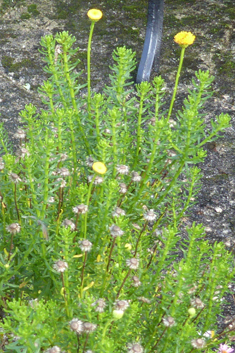
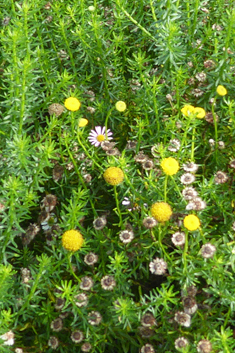
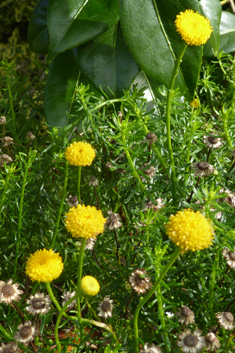
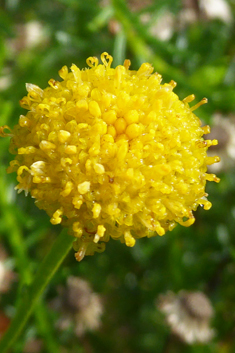
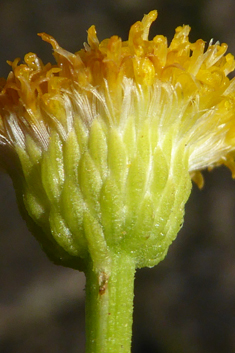
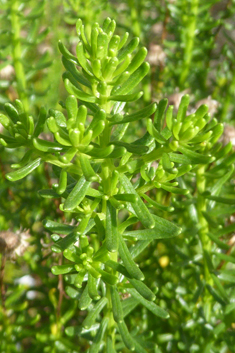
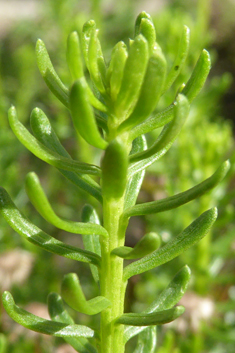
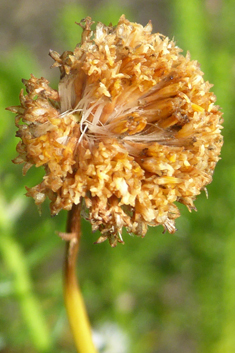
Shrub Goldilocks Chrysocoma cernua
Chrysocoma coma-aurea Introduced from South Africa as a garden ornamental. Recorded from Tresco, St Mary's and St Martin's. An evergreen subshrub to 50cm in height. Leaves 0.3-2cm in length, alternate, hairless. Flowers carried on upright stems above the foliage.
 |
 |
 |
 |
| |
|
|
|
 |
 |
 |
 |
| |
|
|
|
Common Lavender-cotton Santolina chamaecyparissus
Introduced as a garden plant from southern Europe with just a handful of records from the inhabited islands. Flowers July to August. A woody perennial, forming a low bush to 80cm in height. Leaves and stems densely covered in white, cottony hairs.
 |
 |
 |
 |
| |
|
|
|
 |
 |
 |
|
| |
|
|
Cottonweed Achillea maritima
Fomerly native on sandy beaches in the UK, but now extirpated from the country. Last seen on the Isles of Scilly in 1936. Attempts are currently underway to introduce this species at various UK sites. Flowers August to October. A low plant with stems forming clumps, to about 50cm in height. The whole plant is covered in dense, cotton-like, white hairs.
 |
 |
 |
 |
| |
|
|
|
 |
 |
 |
 |
| |
|
|
|