Groundsels


What are they?
The groundsels are closely related to ragworts and fleabanes in the daisy and dandelion family - the Asteraceae. Their flowers can be very similar to those of the ragworts in having strap-like petals or 'rays' around the outside of the compound flowerhead only, with the small florets in the centre being petalless and forming a button-like middle. However, the commoner species tend to differ in having petalless flowerheads that have tubular or cone-shaped bases. These are mostly small, annuals species, often with a rather 'weedy' appearance to them.
Where are they found?
These are generally plants of open, usually disturbed ground, such as cultivated fields, allotments, gardens and similar places. Some species can also be found on open heaths or on beaches and habitat can be useful in aiding identification.
Identification
These small plants have tubular or cone-shaped flowerheads that are carried in open, branching clusters above deeply lobed leaves. The presence or absence of ligules (strap-like petals) should be noted, while the type of hairs on the leaves and whether these are sticky or not should also be noted.
Common Groundsel Senecio vulgaris
Native and abundant in almost any habitat, though most frequent in cultivated or disturbed ground. Flowers throughout the year. An ephemeral species, capable of producing several, short-lived, populations over the course of year. May grow to around 45cm in height and well-branched, but often much smaller. There is a variety that has short, petal-like ligules, but these are rarely recorded in our region. Fully developed individuals have pendulous flowerheads, but small plants may have upright flowers. The leaves are very variable, from almost hairless to having a good covering of simple, white hairs, especially on the underside.
 |
 |
 |
 |
| |
|
|
|
 |
 |
 |
 |
| |
|
|
|
Heath Groundsel Senecio sylvaticus
Native on light, sandy soils throughout most of the islands. Flowers July to September. Often rather tall and well-branched, growing to 70cm or so in height, but may also be much smaller. Flowering stems broadly spreading and many-branched. The leaves typically with neatly impressed veins and lightly hairy; non-sticky or only slightly sticky to the touch. The small, outermost phyllaries at the base of the flowerhead are typically less than a third the length of the upper phyllaries.
 |
 |
|
 |
| |
|
|
|
 |
 |
 |
 |
| |
|
|
|
Sticky Groundsel Senecio viscosus
Although occasionally recorded by visitors, no records have yet been accepted for the islands. Flowers July to September. Typically a short species, growing to 30cm or so in height, but may also be much smaller. The leaves typically have neatly impressed veins and are distinctly hairy and sticky to the touch. The small, outermost phyllaries at the base of the flowerhead are typically more than a third the length of the upper phyllaries.
 |
 |
 |
 |
| |
|
|
|
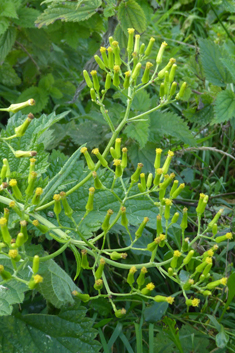
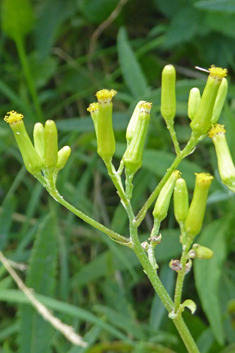
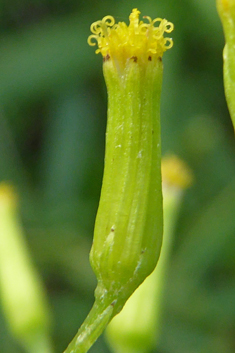
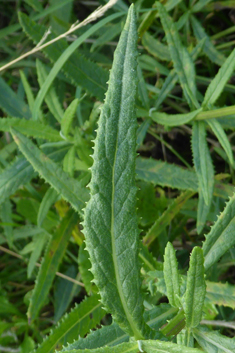
Toothed Burnweed Senecio minimus
Introduced from Australia, probably accidentally as a weed via Tresco Abbey Gardens and rapidly becoming established on the larger islands. Flowers August to October. Plants up to one metre in height. Leaves simple but with strongly toothed or serrated margins.
 |
 |
 |
 |
| |
|
|
|