The Pittosporum Family
What are they?
This is a family of woody plants that is largely confined to the southern hemisphere and the tropical regions of the world with just a handful of species introduced into the UK as garden ornamentals. Within the family, the genus Pittosporum is popular as a group of evergreen shrubs that are weather-tolerant of coastal conditions and are commonly planted near the coast for hedging and screening. However, these plants are not fully frost-hardy and are most often found in SW Britain. A single, more hardy species has been cultivated to produce a range of named varieties.
Where are they found?
One species is widely planted in gardens and amenity areas, especially near the coast, where its salt tolerance is a useful attribute in coping with coastal conditions. Occasionally a plant may be found in the wider countryside as a survivor from a previous planting or as a garden throw-out. More recently, a warming climate has allowed self-sown seedlings to persist in urban areas.
Identification
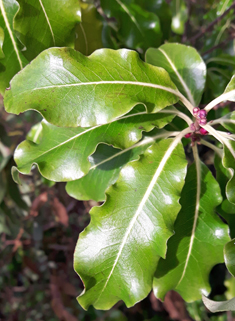
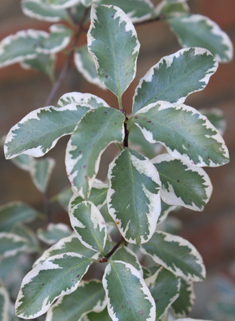
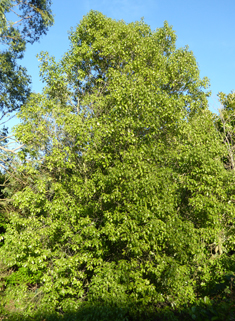
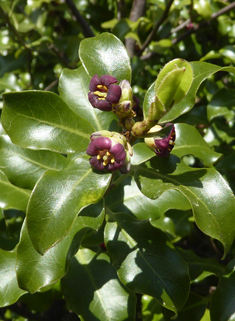
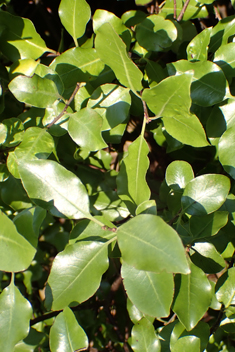
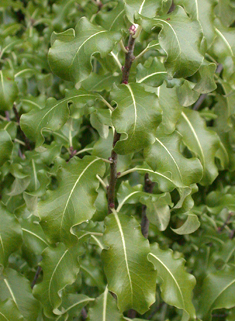
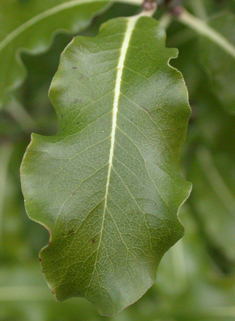
The highly glossy, wavy-edged leaves on blackish, wiry stems of Kohuhu are unlike any of our native plants. Note that leaf shape is rather variable in this species and that a range of forms with bronze, purple, yellow or variegatedleaves is grown.
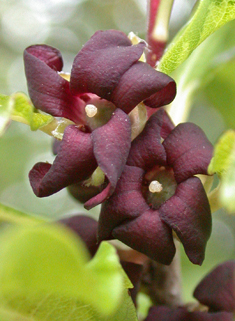
Kohuhu Pittosporum tenuifolium
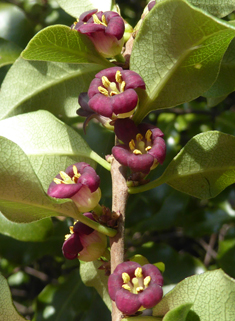
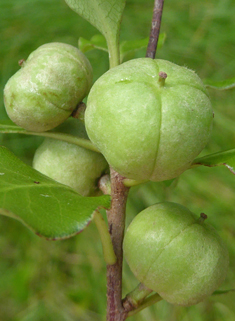
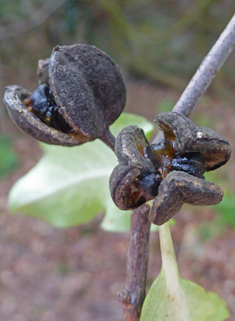
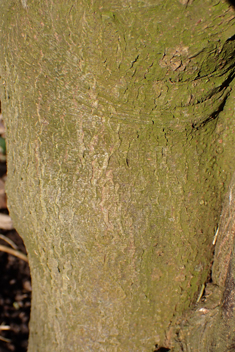
Introduced from New Zealand as a garden ornamental and widely planted for hedging and screening, especially near the coast. In recent years, self-sown seedlings have started to appear in sheltered - usually urban - areas. Flowers April to June. Evergreen shrubs, capable of growing to over 10m in height when free-growing but often cut as hedging. Leaf-bearing branches are thin and wiry and blackish on colour. Leaves are shiny and usually have strongly waved edges. Flowers are five-petalled and deep reddish-purple or maroon in colour and are followed by rounded seed capsules.
 |
 |
 |
 |
| |
|
|
|
 |
 |
 |
|
| |
|
|
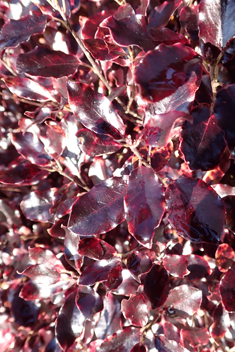
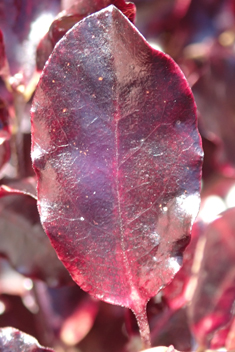
Kohuhu cultivars Pittosporum tenuifolium
In cultivation, Kohuhu has produced a wide range of cultivated varieties which mostly differ in the colour of their leaves. Some are shown here as they may not immediately be identifiable using the details given under the species above. In particular, the cultivar 'Tom Thumb' forms a small, rounded bush and is often used in amenity plantings in more formal situations.
 |
 |
|
| |
|
|
 |
 |
|
| |
|
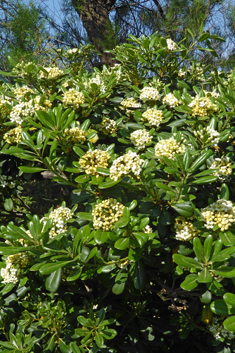
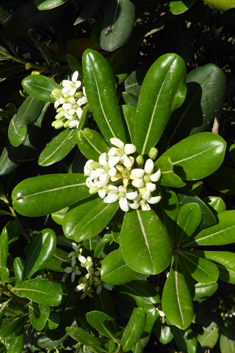
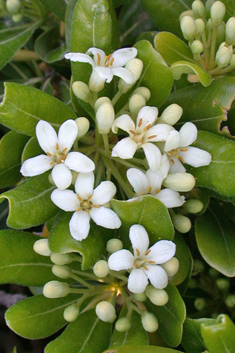
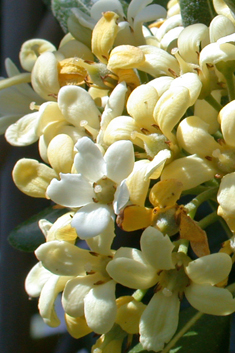
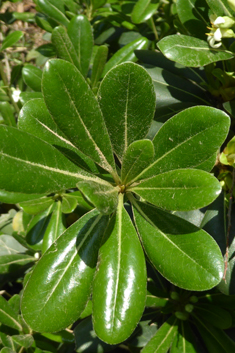
Japanese Cheesewood Pittosporum tobira
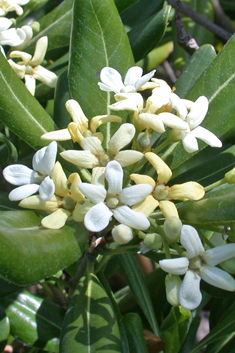
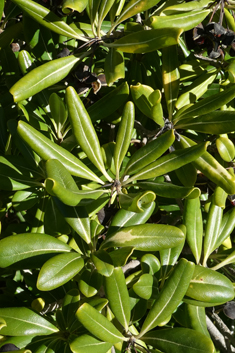
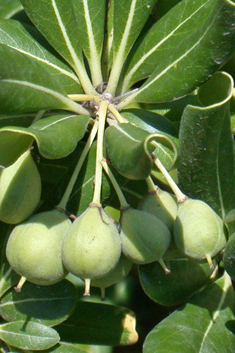
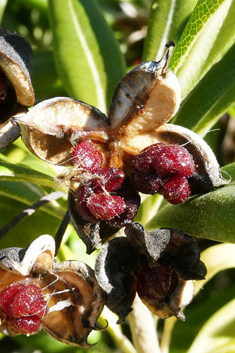
Native to South Korea and Japan and introduced as a garden ornamental. For a long time, this species has not been fully hardy in the UK, but it is surviving the milder winter we now have and may become more frequent as an amenity plant in urban areas. Flowers May to September. An evergreen shrub, capable of growing to over 5m in height when free-growing but often cut as hedging. Leaves are glossy and leathery, up to 10cm long and often become reflexed along their length as they age. Flowers are five-petalled, white, fading to yellowish-cream and very heavily scented.
This plant should be familiar to anyone visiting the Mediterranean region as it is enormously popular as a hedging plant in hotel gardens there.
 |
 |
 |
 |
| |
|
|
|
 |
 |
 |
 |
| |
|
|
|