Sedge Group 9

What are they?
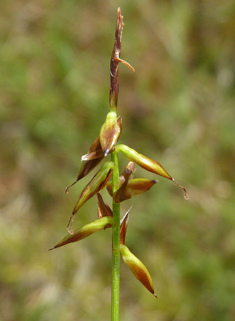
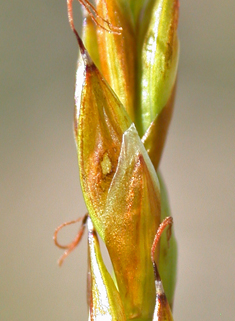
This group includes sedge species that have their flowers and fruits arranged in a single, terminal spike, without any side branches or clustering into spikelets. In East Anglia, this group is represented by a single, small and uncommon species.
Where are they found?
Our one species in this group is tpyically a plant of acid fens and wet places on heathland.
Identification
As there is just one species to consider in this group, the structure of the flower spike with its unclustered flowers should make identification straightforward.
Flea Sedge Carex pulicaris
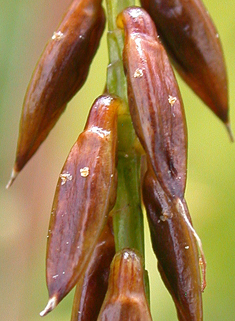
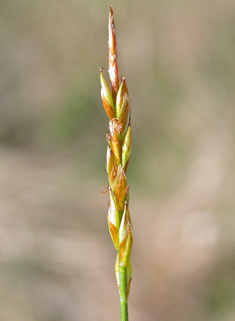
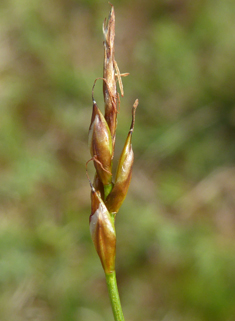
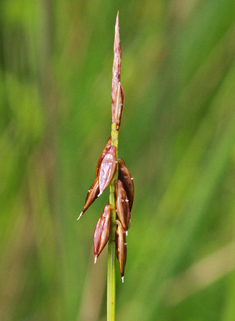
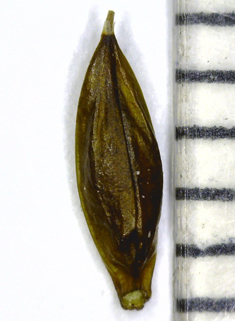
Native. Uncommon to rare in our region and confined to acid flushes in fens and wet areas on peaty heaths. Flowers May to June, fruits June to July. Plants 10-30cm in height, loosely to densely tussocky and spreading by short, creeping rhizomes. Leaves 0.5-1mm wide, keeled and quite stiff. Flower spike rather open, with the individual flowers along a single, central stem. Utricles 3.5-6mm, dark brown and shiny, gradually turning from upright to fully reflexed as they develop.
| |
 |
 |
|
| |
|
|
|
 |
|
|
 |
| |
|
|
|
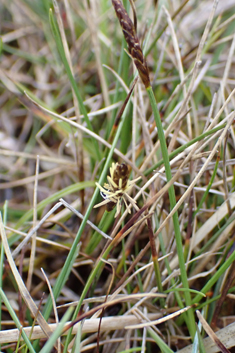
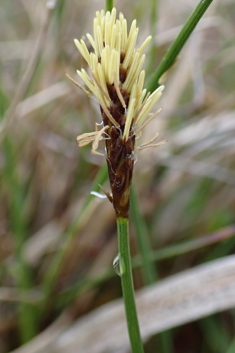
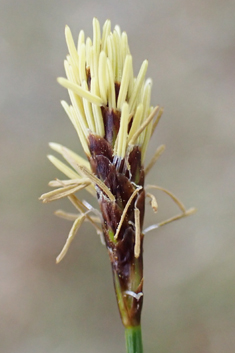
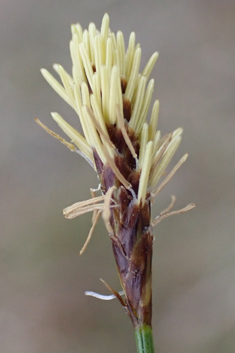
Native. A rare species in our region and confined to acid flushes in fens and wet areas in just two locations in Norfolk. Flowers April to May, fruits June to July. Plants 5-30cm in height, loosely tufted and spreading by creeping rhizomes to produce low mats of stems. Leaves 0.3-1mm wide, rounded at apex. Flower spike dense, with (unusually for sedges) male and female flowers borne on separate plants. Utricles 2.5-3.5mm, reddish to purplish brown with dark ribs.
Plants could easily be mistaken for a spike-rush, but the stems have fully developed leaves towards their bases, rather than leaves reduced to sheath-like collars.
 |
 |
 |
 |
| |
|
|
|
 |
 |
 |
|
| |
|
|